Business
When Is It Worth Switching from OSVČ to s.r.o.?
· 8 min read
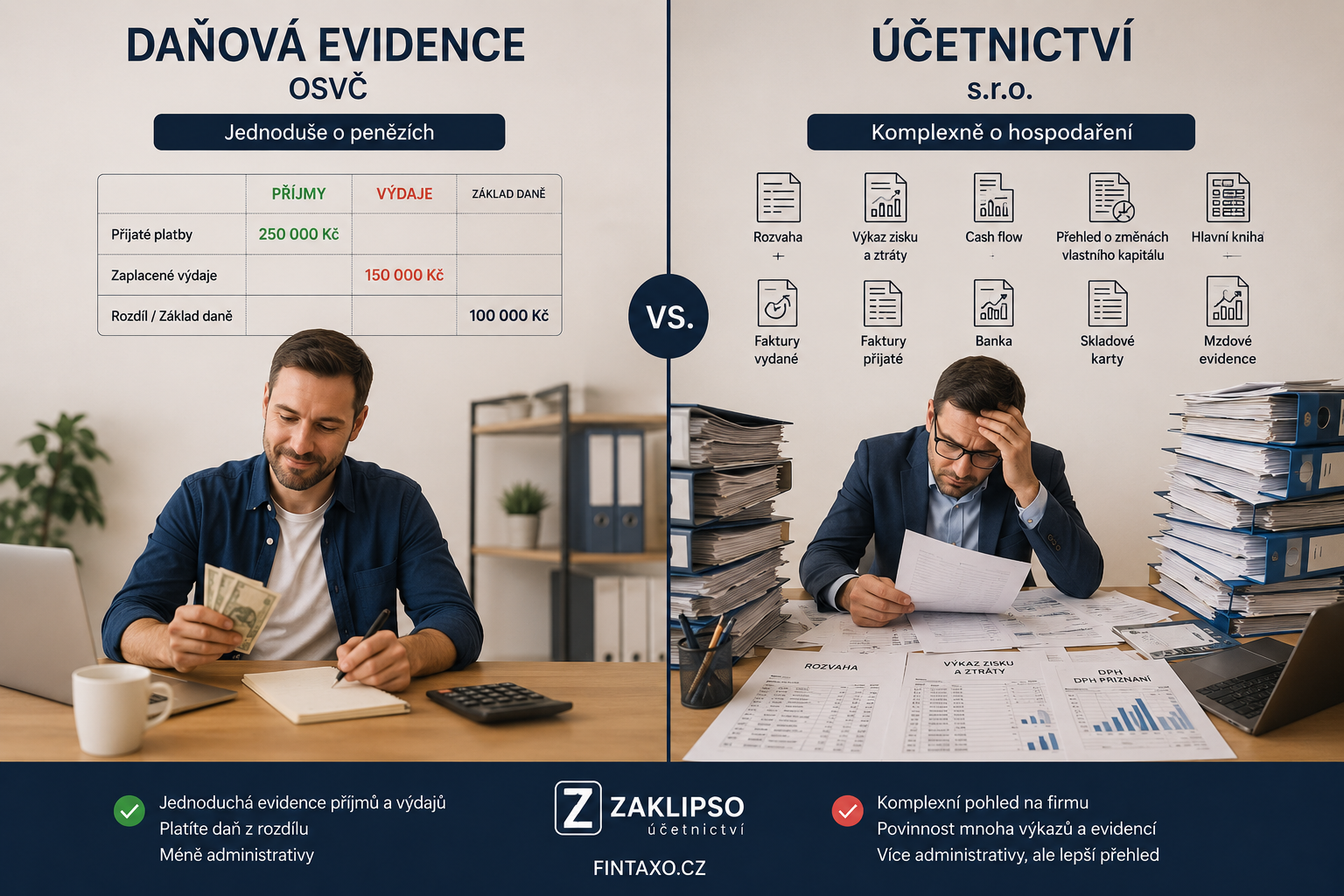
There is no universal answer to when an s.r.o. (limited liability company) is more advantageous than an OSVČ (sole trader). It depends on the level of profit, business risk, number of employees, and the method of record-keeping. Here are the key differences every entrepreneur should consider.
1. Liability for Obligations
An OSVČ is liable for their business obligations with their entire personal estate. If debts arise towards suppliers, the tax authority, or clients, personal assets may also be affected. An s.r.o. is liable for its obligations with company assets. Shareholders generally bear no personal liability (once their registered capital contributions are fully paid up). However, the managing director (jednatel) is accountable for the proper performance of their duties and may face liability, for instance, in the event of a breach of the duty of due managerial care (péče řádného hospodáře). In practice: If you operate in construction, run an e-commerce shop, or provide services with higher exposure to damage claims, an s.r.o. is generally the safer option.
2. Social Security and Health Insurance
For an OSVČ, both social security and health insurance contributions depend on the achieved tax base. As profit increases, mandatory contributions rise as well. ČSSZ (Czech Social Security Administration) and health insurance funds recalculate advance payments annually based on the submitted Overview of Income and Expenditure (Přehled o příjmech a výdajích). In an s.r.o., the company itself does not pay social security or health insurance on its corporate profit. Contributions arise only based on the manner in which the managing director or employee is paid remuneration (salary, director's remuneration, etc.). Therefore, at higher profit levels, it is often worthwhile to compare the total tax and contribution burden of both options.
3. Lump-Sum Expenses Can Be a Major Advantage for an OSVČ
One of the greatest advantages of an OSVČ is the option to claim lump-sum expenses (for example, 60% for most standard trade licences) without having to substantiate actual expenses. Example: Annual revenue of 2 000 000 CZK. • Revenue: 2 000 000 CZK • 60% lump-sum expenses: 1 200 000 CZK • Tax base: 800 000 CZK In reality, the entrepreneur might only spend 300 000 CZK on operational costs, meaning they are taxed on only 800 000 CZK despite having a real profit of 1 700 000 CZK. Nothing comparable exists for an s.r.o. — it can only claim actual, tax-deductible expenses. If you operate with minimal business costs (such as IT, marketing, consulting, or accounting), operating as an OSVČ with lump-sum expenses is often significantly more tax-efficient.
4. Accruals and Revenue Timing
This is a difference that many entrepreneurs underestimate. Example: In November, you receive an advance payment of 1 000 000 CZK for a project that you will not complete until February of the following year. For an OSVČ keeping tax records (daňová evidence), a received advance is generally treated as taxable income affecting the tax base in the year it is received. It can therefore inflate your tax base before the contract is finished. In an s.r.o., a received advance is booked as a liability towards the customer. It enters revenues only when the delivery of goods or services is completed in accordance with accounting rules. The exact same contract can thus be taxed in a different accounting period, which is especially advantageous for larger projects or long-term contracts.
5. Simpler Administration for an OSVČ
An OSVČ can maintain simple tax records (daňová evidence), keep records of income when using lump-sum expenses, or enter the flat-rate tax regime (paušální daň) if statutory conditions are met. An s.r.o. must always maintain statutory double-entry bookkeeping (podvojné účetnictví). This entails annual financial statements, asset and liability inventory checks, accounting depreciation, accruals and deferrals, provisions, estimated balances, and the statutory obligation to publish financial statements in the Commercial Register's Collection of Documents (Sbírka listin). Administrative requirements and accounting service costs are therefore typically higher.
6. Employees and Employment Law Obligations
If an OSVČ does not have employees, many statutory obligations do not apply. However, as soon as workers are employed (whether by an OSVČ or an s.r.o.), obligations under Czech labour law arise immediately. If a company director is simultaneously an employee, the performance of the director's statutory role must be strictly separated from the employment relationship. An employment contract must not be concluded for activities identical to the statutory duties of a director. When employing staff, you must also arrange occupational medical examinations according to work categories, OSH (BOZP) and fire safety training, working time records, annual leave administration, and HR documentation. The obligation for occupational medical checks and OSH applies to the existence of an employment relationship, not the legal form of the business. An OSVČ without employees generally has no such obligations towards themselves.
7. Banks and Business Partners
Many larger companies prefer working with an s.r.o., as they view it as a more established and stable business entity. Conversely, for smaller trade licences and freelance activities, an OSVČ is entirely standard and poses no obstacle.
Comparison Table: OSVČ vs s.r.o.
A clear overview of the main differences to help you make a quick decision.
| Area | OSVČ | s.r.o. |
|---|---|---|
| Liability for debts | Entire personal assets of the entrepreneur | Company assets; shareholders generally bear no personal liability |
| Social and health insurance | Contributions based on tax base, increasing with profit | Contributions based on payouts to director/employees |
| Lump-sum expenses | Yes, e.g. 60% without substantiating costs | No, only actual tax-deductible expenses |
| Revenue timing / accruals | Limited; advances are generally taxable upon receipt | Flexible; advances are booked as a liability |
| Record-keeping | Tax records or income records | Statutory double-entry bookkeeping |
| Administrative burden | Lower | Higher |
| Employees | Obligations arise only once staff are hired | Same employment obligations, always double-entry accounting |
| Best suited for | Starting out, low costs, simplicity | Higher risk, substantial profits, employees, investors |
8. When Does an OSVČ Make More Sense?
An OSVČ is usually more suitable when: • you do not wish to spend approximately 8000 CZK on setting up an s.r.o., • your operating costs are low, • you can utilise percentage lump-sum expenses, • you want minimal administration, • you operate a craft trade licence with revenue up to 2 000 000 CZK, • you do not wish to maintain full double-entry bookkeeping.
9. When Is It Worth Switching to an s.r.o.?
Consider switching to an s.r.o. when: • your business involves higher financial or legal risks, • you want a clear separation between personal and company assets, • you deliver long-term contracts involving substantial client advances, • you employ multiple members of staff, • you plan to bring in an investor or business partner, • your profits are already high enough that a detailed comparison of the total tax and contribution burden between OSVČ and s.r.o. is justified.
10. Model Case Study: Cosmetic and Craft Services with Annual Revenue of 350 000 CZK
A frequent question from small-scale sole traders is: with an annual revenue of 350 000 CZK, is an OSVČ or an s.r.o. better? Below is a model comparison for a beautician who also works part-time as a marketing specialist. Assumptions for the OSVČ: • annual revenue of 350 000 CZK, • 80% lump-sum expense allowance, • basic taxpayer tax credit of 30 840 CZK, • mandatory minimum advance payments for social and health insurance, payable even during low-profit periods. Assumptions for the s.r.o.: • annual company revenue of 350 000 CZK, • remuneration under an Agreement on Work Performance (DPP) of 11 999 CZK per month, • remuneration under an Agreement on Working Activity (DPČ) of 4 499 CZK per month, • vehicle fuel lump-sum allowance of 60 000 CZK (which reduces the corporate tax base), • corporate income tax rate of 21%, • the director pays minimum statutory health insurance personally as an individual without taxable income (OBZP) and pays no social security on these agreements.
Value Breakdown for the s.r.o. Director
Here is the summary of the net value realistically flowing to the owner/director of the s.r.o. under this model.
| Item | Amount |
|---|---|
| Paid out via Agreement on Work Performance (DPP) | 143 988 CZK |
| Paid out via Agreement on Working Activity (DPČ) | 53 988 CZK |
| Operating result - 60 000 CZK fuel lump-sum = Corporate Income Tax | 19 325 CZK |
| Subtotal | 132 699 CZK |
| Minimum health insurance (person without taxable income), paid by director personally | −39 672 CZK |
| Total value for s.r.o. director/owner (DPP, DPČ, and taxed profit share) | 271 398 CZK |
Result Comparison: OSVČ vs. s.r.o. at 350 000 CZK
OSVČ: • approximately 241 000 CZK remains, • both social security and health insurance are fully covered, • contributions count towards state pension qualifying years, and sickness insurance coverage applies if registered. s.r.o.: • approximately 271 398 CZK is paid out to the director, • part of the funds remains in the company if there are no other expenses (vehicle rental, partner agreements, travel allowances, asset purchases), • the director pays no social insurance on these specific agreements under this model, • consequently, no entitlement to state pension accrual or statutory sick pay arises from this structure.
Key Takeaways from the Model
If you earn less than roughly 350 000 CZK per year, an s.r.o. can appear more attractive on paper because you avoid paying a large portion of your income into mandatory insurance. An OSVČ must pay minimum mandatory contributions even during periods with zero earnings. In a company, you can adapt your personal remuneration and associated contributions based on how well the business is performing. The trade-off is reduced social protection. If pension qualification and statutory sick pay matter to you, keep in mind that this model does not provide them. Once the company grows, the shareholder can employ you as managing director on a standard full-time employment contract, thereby providing full social insurance coverage. Note that a managing director cannot legally employ themselves as an individual. Please note: This is a model calculation based on the specified assumptions. The exact outcome depends on your income structure, costs, and remuneration setup — we can review your exact numbers during a consultation.
Summary
For entrepreneurs with low operational expenses, an OSVČ is often the most cost-effective option thanks to percentage lump-sum expenses, streamlined administration, and lower accounting costs. However, as turnover, profits, staff numbers, or commercial risks increase, an s.r.o. becomes far more suitable for asset protection, revenue planning, and projecting a corporate image. There is no single threshold of turnover or profit where the switch becomes automatically worthwhile. The decision should always be based on an individual comparison of tax impacts, mandatory contributions, administrative workload, and commercial needs. FinTaxo Tip: Unsure which legal structure is more advantageous for you in 2026? Book our Mini Audit or a non-binding consultation — we will analyse your figures and suggest the optimal solution.
Author: FinTaxo expert team
Operated by: Zaklipso s.r.o.
Czech original: read this article in Czech
This article is general information and does not replace individual tax, accounting or legal advice. Czech legislation changes frequently — verify the current wording or discuss your situation with us before acting on it.
Need help with this in practice?
We go through your situation in a free consultation in English and tell you exactly what has to be registered, filed and paid.
Czech accounting news, once a month
Practical updates on Czech taxes, VAT and payroll — concise and spam-free. Unsubscribe anytime.
By subscribing you consent to the processing of personal data under GDPR and to their use for the marketing purposes of FinTaxo, operated by Zaklipso s.r.o.. You can withdraw your consent at any time. See our privacy policy.